

Call Now: (504) 305-8727
Call Now: (504) 305-8727

Heated floors are usually sold as a heating upgrade. In a market with a short heating season they are better understood as a comfort upgrade for specific rooms, and that reframing is what decides whether the money is well spent.
Radiant floor heating comes up most often when somebody is already replacing a floor, and that is the easiest time to act on it. The pitch is warm tile underfoot and even heat with no vents blowing. The question nobody asks early enough is a simple one: how many weeks a year would you actually run it, and in which rooms?
At Big Easy Flooring, we install heated floors, and we would rather tell you where they pay off than sell you a system for a room that does not need one. If you want it assessed against your actual floor plan, contact us about your flooring project. Let’s break down where the honest yes and the honest no sit.
It heats the surface you stand on rather than the air you move through. The heat comes up through the floor into the room, instead of arriving through a vent at the ceiling and working its way down.
That mechanical difference is the whole reason the comfort feels different, and it is also why the floor covering on top matters more than most people expect.
The US Department of Energy is direct about this. Ceramic tile is the most common and effective floor covering for radiant floor heating, because it conducts heat well and adds thermal storage. Vinyl, linoleum, carpet and wood can all be used, but any covering that insulates the floor from the room will decrease the efficiency of the system.
In practice that means the same heated floor performs very differently depending on what you put over it. If carpet is the plan, the DOE’s guidance is to use a thin carpet with dense padding and install as little of it as possible. It also notes that if some rooms have a covering and others do not, those rooms should be on a separate tubing loop, because the water under a covered floor has to run hotter to do the same job.
So the decision is not really “do I want heated floors.” It is closer to “which rooms am I tiling,” because tile is the covering the DOE names as the most effective. Other coverings work, they just cost efficiency, and the DOE says so directly.
The other DOE point worth knowing before you spend anything: electric radiant floors are usually only cost-effective if they include a significant thermal mass, such as a thick concrete floor, and your electric utility offers time-of-use rates.
Where the thermal mass is large enough, the stored heat will keep the house comfortable for eight to ten hours without any further electrical input, and that effect is strongest when daytime temperatures are significantly warmer than nighttime temperatures.
That last clause is worth rereading, because a day-to-night temperature swing is exactly the pattern the storage effect depends on. Whether your own winter fits it is the thing to check.

Partly, and the honest answer depends entirely on what you are trying to buy.
The house already has a heating system, and a whole-home radiant retrofit is a large intervention to duplicate something that already works. Before anyone prices it, work out how many days a year you would actually call for heat. That number, not the technology, is what decides whether a whole-home system earns its place.
There is a second reason the whole-home version disappoints, and it follows from the DOE guidance above. A house heated entirely by radiant floors only performs well if the floor coverings cooperate throughout, which means tile nearly everywhere. A home with a mix of tile, wood and carpet, which is a common enough arrangement, ends up with a whole-home system working against its own floor plan in the rooms that are not tiled.
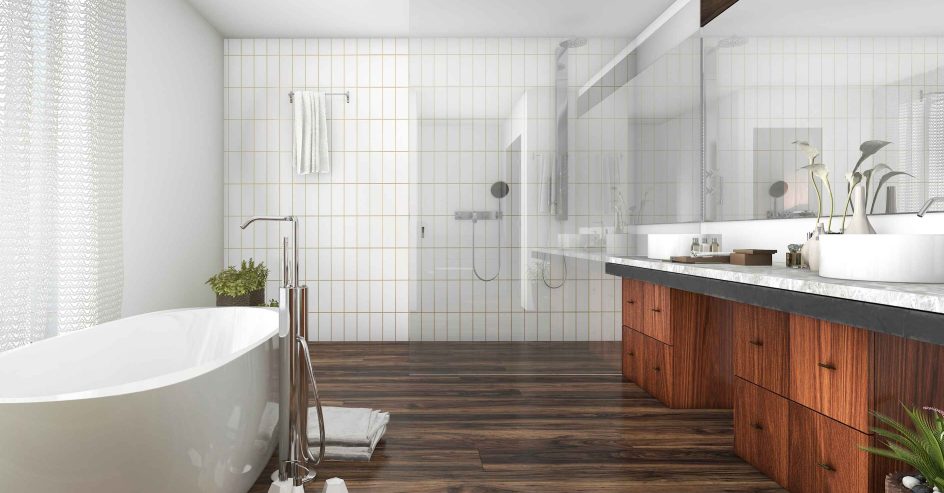
A tiled bathroom floor on a January morning is unpleasant in a way that has nothing to do with the thermostat reading, because tile pulls heat out of your feet regardless of the air temperature. That is the problem radiant heat solves cleanly, in the room where it is most noticeable, at the smallest scale.
Scale is doing a lot of work in that sentence. A single bathroom is a small heated area, a small control zone and a small addition to a floor job you are already paying for. The same system spread across a whole ground floor is a different project with a different answer.
A slab home has the thermal mass the DOE describes, which is one of the two conditions it names. The other is a time-of-use rate from your electric utility, and the DOE is explicit that electric radiant floors are usually only cost-effective when both are present. So a slab gets you halfway, and the rate structure on your own account decides the rest. Check that before anyone quotes a system.
A raised home on piers does not have that mass in the same way, so the storage behavior the DOE describes is not what you would be buying. Ask the installer how the proposed system is expected to perform in your specific floor assembly rather than assuming the slab case applies. Neither situation is wrong, they are just different products, and the sales conversation rarely distinguishes them. It changes how you would use the thermostat and what to expect on a cold morning.

Here is the part that actually determines whether this is a good buy or a bad one, and it has nothing to do with the technology.
Radiant floor heating goes under the floor. Installing it means the floor comes up. If you are already tearing out a bathroom floor and putting tile down, adding a heating layer is an incremental decision on a job that is happening anyway. If the floor is fine and you are opening it purely to add heat, you are paying for the entire floor replacement to get the heating, and the value proposition falls apart.
Which is why the strongest candidates are the projects where a floor is coming up anyway. Anyone whose floors are sound is generally better served waiting until they are not.
That is not a brush-off, it is the right sequence. Floors get replaced eventually, and a bathroom due for retiling in three years is a far better candidate then than it is today. Noting it now and deciding then costs nothing.
It also means the decision has a deadline. Once the new tile floor is down, adding radiant heat later means taking it back up. This is a decision that has to be made before the substrate work starts, not after somebody feels a cold floor in December.
Bathrooms get all the attention and they deserve most of it. But two others are worth a thought.
Tiled entryways and mudrooms in raised homes can sit over open or vented space underneath, and a floor over unconditioned space tends to run colder than one over a slab. If that area is being retiled, it is worth assessing.
Kitchens are the one people ask about most and the one that needs the closest look at the layout. Cabinets, appliances and islands take up floor area nobody stands on, so a share of any heated area there does nothing for anyone. If the kitchen is being done anyway and the plan has real standing space, it can work. Measure the standing area before deciding rather than heating the footprint.
Bedrooms come up occasionally and deserve a skeptical look, partly because the covering many people want in a bedroom is one the DOE notes will insulate the floor from the room, and partly because the hours the room gets used are the hours nobody is standing on it.
One planning note for any of these rooms. A heating layer adds to the total floor build-up, and how much depends on the system specified, which matters at doorways and at thresholds where a heated room meets an unheated one. Check the figure for the specific system during planning, because it is easy to design around then and awkward to solve after the tile is set.
For the comfort and efficiency side of the argument, our earlier piece on the benefits of radiant heat flooring covers that ground, and this post has deliberately stayed off it.
Radiant floor heating in a New Orleans home tends to be worth it when three things line up: you are already replacing the floor, the covering going down is tile, and the room is one where a cold floor is genuinely unpleasant rather than merely noticeable. A slab underneath, paired with a time-of-use rate, strengthens the case further.
The disappointments tend to come from three places: buying it as a replacement heating strategy when the existing system already covers the season, opening a sound floor purely to install it, and putting it under a thick carpet that works against it. Whether the first of those applies to your house depends on how much heating you actually call for, which is worth working out before you commit.
Here at Big Easy Flooring, we handle radiant floor heating across the New Orleans metro, usually as part of a floor we are already installing.
Tell us which rooms are coming up and what is going down, and we will tell you which of them are worth heating and which are not. Call us at (504) 305-8727.
 By Big Easy Flooring
  Sep 7, 2026