

Call Now: (504) 305-8727
Call Now: (504) 305-8727

If your garage floor is bare, dusty concrete that stains every time a car drips on it, a coating is one of the few upgrades that changes how the space works and how it survives this climate. The catch is that the finished floor everyone photographs is the last ten percent of the job. The ninety percent underneath it, the testing, grinding, and repair work, decides whether the coating lasts twenty years or peels in two.
That is not a scare line. The International Concrete Repair Institute published its surface preparation guideline, ICRI 310.2R, specifically because the industry was seeing large numbers of coating failures caused by concrete that was never properly profiled before the coating went down. The failure mode is almost never the product. It is the prep.
At Big Easy Flooring, we install floor coatings on garage slabs across the New Orleans metro, and every job follows the same sequence regardless of the color or finish the owner picks.
This post walks through that sequence step by step, so you know exactly what a proper installation looks like before anyone opens a bucket in your garage. If you would rather talk through your own floor first, contact us and we will take a look at it.
The coatings industry has repeated the same estimate for years: the large majority of concrete floor coating failures trace back to moisture or inadequate surface preparation, not to the coating products themselves. Every step below exists to keep your garage floor out of that statistic.
A floor coating does not stick to concrete the way paint sticks to drywall. It anchors into it, mechanically, by flowing into an opened surface texture and locking in as it cures. Concrete that is smooth, sealed, or contaminated gives the coating nothing to grip.
 Three conditions have to be true at the moment the first coat goes down. The surface must carry the right profile, a measurable roughness graded on the ICRI Concrete Surface Profile scale, where diamond grinding produces the CSP 1 to 3 range that thin coating systems are designed for. It must be clean, free of oil, old sealers, and the fine dust grinding leaves behind. And it must be dry enough, meaning moisture moving up through the slab sits below the limits the coating manufacturer publishes.
Miss any one of the three and the failure is already scheduled. It just has not happened yet.
Time is the honest test here. A coating bonded to a properly prepared slab wears from the top down, slowly, at the surface where life happens. A coating on a badly prepared slab fails from the bottom up, letting go in sheets, and no topcoat quality can rescue a bond that never formed.
In plain terms: the coating is only as good as the surface under it, and in New Orleans the surface under it is a slab poured on some of the wettest, most movement-prone ground in the country. That is why the process below spends four steps on the slab before any color appears.
Every installation starts with an honest read of the concrete itself, before any equipment comes off the truck.
Moisture deserves its own conversation in this city, and we have already written it. Our guide to getting a slab ready for coating covers the testing standards and what high readings mean for a New Orleans garage. For this post, the point is simpler: the test happens first, every time.
The inspection also decides logistics. Cars out, storage cleared or shifted, and a realistic schedule set, because cure times are chemistry and cannot be rushed by wishing.
New Orleans slabs move. Much of the metro sits on soft delta soils that settle unevenly, and garage floors show it as hairline cracks, corner spalls, and joints that have widened over the years.
The cracking itself has a local explanation. Much of the metro’s housing sits on soft, settling ground, and garage slabs, often the least reinforced concrete on the property, record that movement first. Repairing the symptoms is standard. Pretending the slab will stop moving is not, which is why crack repair here leans on materials that grind flush and move with the floor.
None of this repair work is glamorous, and all of it shows through the finish if it is skipped. A coating is thin. It telegraphs everything underneath it.
This is the step that separates professional installation from a weekend kit, and it is the reason a proper crew arrives with dust-shrouded grinders instead of a mop and a jug of acid.
Acid etching, the shortcut the DIY kits recommend, cannot produce a reliable profile on a hard-troweled garage slab, and it leaves the etching residue itself to interfere with the bond. Grinding is slower and louder. It is also why the floor holds.
After grinding, the crew vacuums the entire slab and wipes test areas to confirm the surface is clean and open. The concrete at this stage looks matte and slightly rough, like fine sandpaper, and it drinks water instead of beading it.
With the slab open and clean, the first liquid goes down, and the first liquid is never the color coat.
The primer decision is one owners never see and always live with. Standard primers suit slabs that tested dry. Moisture-mitigating epoxy systems exist for the slabs this metro actually has, where a vapor barrier under the concrete is a coin flip on anything built before modern code. The test results from Step 1, not habit, make the call.
This is also where the system choice made during the estimate becomes physical. A solid-color epoxy build, a full-broadcast flake system, or a coating over decorative work all start from this same primed base. Owners who want stained concrete looks inside the house often pair a garage project with our stained concrete work, but the garage itself almost always gets the tougher coating build.
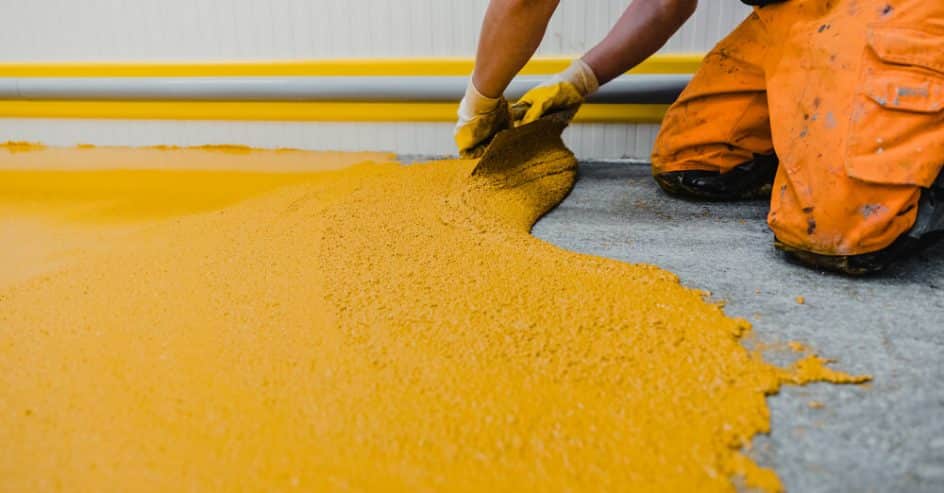
The body coat is the layer with the color, the thickness, and most of the coating’s strength, and on flake systems it is also the glue that holds the decorative broadcast.
The look itself is a real decision, not an afterthought. Solid colors read clean and show dust less than owners expect. Flake blends hide the daily grit of a working garage and carry texture in the finish. Both are garage-appropriate, so the choice is honest preference rather than performance.
Once the broadcast coat cures, excess flake gets scraped and vacuumed off, leaving the texture that gives a garage floor its grip underfoot. What looks like a finished floor at this stage is not one yet. Without its topcoat, the surface would stain, scuff, and chalk.
The clear topcoat is the wear surface, the layer your tires, jack stands, and dropped tools actually touch, and its chemistry is chosen for exactly those abuses.
The crew’s last pass covers final inspection, edge detail, and joint work, and then the floor needs the one thing no crew can apply: time. Parking on a coating before it reaches full cure is the single most common way owners damage a brand-new floor, so we put the return-to-service dates in writing before we leave.
Living with the finished floor is simple. Sweep the grit, hose or mop the spills, and keep sharp point loads like unpadded jack stands off the surface. A coating installed on this sequence does not ask for much, because the hard work is already underneath it.
Every step above exists because a step like it has failed somewhere: a coating laid over a sealed slab, a moisture test skipped, a floor etched instead of ground. The process is not complicated, but it is unforgiving, and this city’s wet ground and hot summers punish shortcuts faster than most markets.
We bring the grinders, the testing, and the repair work to every garage job, and we put the whole sequence on a schedule you can plan around. Our crews handle epoxy flooring and coating systems across the metro, from single-car garages to full commercial floors.
If your garage floor is ready to stop being bare concrete, we are ready to walk it with you. Call Big Easy Flooring today at (504) 305-8727 and let’s get your slab on the calendar.
Most single garages run one to three days on site, depending on the repair work and the system installed. Cure time is separate: plan on days, not hours, before vehicles park on the new floor.
Yes. Grinding reaches wall to wall, and dust control works best in a cleared space. Most owners stage their storage in the driveway or a rented pod for the few days the work takes.
Cracks get repaired before coating, not covered by it. Routed and filled properly, they disappear into the finished floor, though a slab that is still actively settling can eventually telegraph new movement through any coating.
Grinding produces the measurable surface profile coating systems specify and removes sealers and contamination etching leaves behind. On the hard-troweled slabs found in most garages, etching alone cannot create a reliable bond.
No, crews install year-round here. Heat shortens working time and humidity has to be managed, but both are handled with scheduling and batch control, and the products themselves are chosen for this climate.
 By Big Easy Flooring
  Aug 24, 2026